Inflammatory bowel disease (IBD) in London and Essex
IBD is a long-term condition where the gut becomes inflamed. It can cause tummy pain, diarrhoea, blood in your stool or tiredness, often with flare-ups. Dr Ahmad can confirm the diagnosis with the right tests and help you get the condition under control.
- Consultant Gastroenterologist and Specialist Endoscopist at St Mark's, The National Bowel Hospital
- PhD in colonoscopy quality, Imperial College London
- 4,500+ procedures
Consultations usually available within 1 to 2 weeks, including evenings and weekends, in person or remotely.

The condition
IBD at a glance
The key facts about inflammatory bowel disease (IBD), from the signs to look for to when to get checked.
Signs
Ongoing diarrhoea, tummy pain or cramps, blood or mucus in your stool, tiredness and weight loss, often with flare-ups followed by quieter spells.
Types
The two main types are Crohn's disease, which can affect any part of the gut, and ulcerative colitis, which affects the large bowel and rectum.
Causes
The exact cause is not known. An overactive immune system, genes and environmental factors such as smoking can all play a part.
Get checked
Diarrhoea, blood in your stool or tummy pain that lasts more than a few weeks is worth a proper assessment, so that IBD is not missed.
Urgent
Seek same-day medical help if you have bloody diarrhoea six or more times a day, especially with a fever, fast heartbeat or feeling unwell, as this can be a severe flare. Weight loss you can't explain or waking at night with symptoms need prompt review. If you have heavy bleeding or severe pain, call 999 or go to A&E.
Next step
A consultation with Dr Ahmad to review your symptoms, arrange blood and stool tests or a colonoscopy if needed and agree a plan.

The condition
What is inflammatory bowel disease (IBD)?
IBD is a long-term condition in which the immune system causes inflammation in the gut. The two main types are Crohn’s disease and ulcerative colitis. The bowel lining becomes inflamed and can be damaged, which is why scans and camera tests usually show changes in IBD. IBD is not the same as IBS, and with the right treatment most people can keep it well controlled.
IBD is diagnosed from your symptoms, together with blood and stool tests to check for inflammation, and usually a colonoscopy with small samples (biopsies) to confirm it. Dr Ahmad will listen to your symptoms and ask about your diet, medicines and family history. An MRI scan or capsule camera may be used if the small bowel needs to be checked, which is common in Crohn’s disease.
IBD often causes:
- Tummy pain or cramps, often with diarrhoea
- Blood or mucus in your stools
- Tiredness or weight loss, with flare-ups that come and go
Crohn's disease or ulcerative colitis?
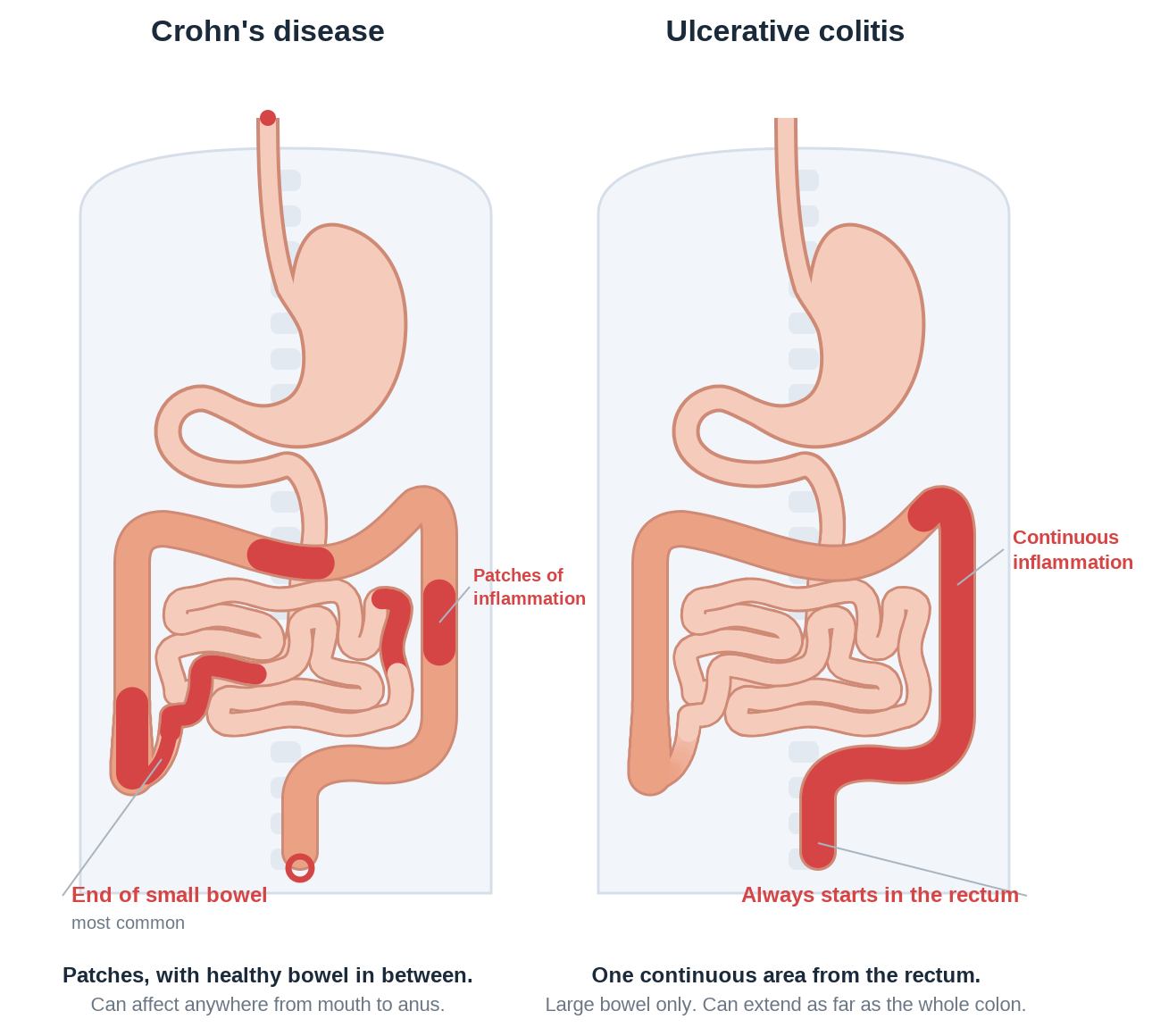
Crohn's disease and ulcerative colitis are the two main types of inflammatory bowel disease (IBD). They can cause similar symptoms, but they affect the gut in different ways. Knowing which one you have helps us choose the right treatment and plan your follow-up.
Crohn's disease
Inflammation appears in patches, with healthy bowel in between. It can affect any part of the gut, from the mouth to the back passage, although the end of the small bowel is the most common site.
Ulcerative colitis
Inflammation is continuous, in one unbroken area. It always starts in the rectum and affects the large bowel only, and it can extend as far as the whole colon.
Symptoms they share
Both conditions can cause diarrhoea, stomach pain, tiredness, weight loss and blood in the stool. Symptoms often come and go, with flare-ups followed by quieter periods.
How we tell them apart
We usually combine blood and stool tests with a colonoscopy. During the test we look at the lining of the bowel and take tiny samples (biopsies). Scans of the small bowel can also help. The pattern of inflammation, where it sits and how it looks, is what separates the two conditions.
When to see a doctor
Please get checked if you have diarrhoea lasting more than a few weeks, blood in your stool, or unexplained weight loss or low iron. An early diagnosis means treatment can start sooner.
Book a consultationTypes of inflammatory bowel disease (IBD)
IBD is grouped by where the inflammation is and how it looks on tests. Your type helps guide treatment.
Crohn’s disease
Inflammation that can affect any part of the gut, often with pain, diarrhoea and tiredness.
Ulcerative colitis
Inflammation of the large bowel and rectum, often with bloody diarrhoea and urgency.
IBD-unclassified (IBD-U)
Inflammation in the large bowel that can’t yet be clearly labelled as Crohn’s or ulcerative colitis.
Your diagnosis can become clearer over time.
Possible causes of inflammatory bowel disease (IBD)
No single cause has been found. Several factors can combine, and they differ from person to person.
Overactive immune system
The immune system can attack the lining of the gut by mistake, causing ongoing inflammation.
Genes and family history
Having a close relative with IBD raises your risk, although most people with IBD have no family history.
Smoking and environment
Smoking raises the risk of Crohn’s disease, and diet and where you live may also play a part.
Past gut infection
A stomach bug may trigger inflammation in some people who are already at risk.
Gut bacteria
Changes in the balance of bacteria in the gut may play a part.
Some medicines
Anti-inflammatory painkillers (NSAIDs) and some antibiotics may trigger flare-ups in people with IBD.
Why choose Dr Ahmad for your inflammatory bowel disease (IBD) assessment?
Expert care, clear answers and support at every step.
Consultant-led care
Dr Ahmad sees you himself, from your first consultation to your results. He is a consultant gastroenterologist with a PhD from Imperial College London, has published widely on endoscopy and has carried out more than 4,500 procedures.
Seen quickly
Consultations are usually available within 1 to 2 weeks, including evenings and weekends, in person or remotely.
Tests and support in one place
Blood and stool tests, and a colonoscopy with biopsies if needed, can be arranged through Dr Ahmad, so you aren’t passed between services. He can also refer you to a specialist dietitian at Welbeck London and help coordinate ongoing IBD care.
A plan you understand
You leave with a clear explanation of what may be causing your symptoms, which tests (if any) you need, and what happens next.
How inflammatory bowel disease (IBD) is diagnosed
From your first appointment to a clear answer.
Consultation
Dr Ahmad listens to your symptoms, diet, medicines and family history.
Examination
An examination of your tummy and, if needed, a rectal examination.
Tests if needed
Blood tests for anaemia, inflammation and vitamin levels, and stool tests, including faecal calprotectin, to check for inflammation and rule out infection.
Camera test and scans
A colonoscopy with small samples (biopsies) to confirm the diagnosis, and sometimes an MRI or other scan to look at the small bowel.

Your specialist, Dr Ahmir Ahmad
Consultant Gastroenterologist and Specialist Endoscopist
Dr Ahmad qualified in medicine from University College London in 2010. He completed a four-year specialist endoscopy fellowship at St Mark’s Hospital from 2018 to 2022, and a PhD at Imperial College London in 2023 on improving the quality of colonoscopy, so that polyps and early bowel cancers are found more reliably. He has a special interest in diagnosing bowel conditions such as inflammatory bowel disease (IBD) and in making sure other causes of your symptoms are not missed. He continues to see patients and perform colonoscopy at St Mark’s, The National Bowel Hospital, and has carried out more than 4,500 procedures.
- Qualifications MBBS, BSc, MRCP, PhD
- Professional registration GMC 7090128 · Specialist Register
- Practises at Welbeck London · Nuffield Brentwood · Spire Hartswood · St Mark’s TrustPlus
- Experience 4,500+ procedures
Medically reviewed by Dr Ahmir Ahmad. Last reviewed 28 October 2026.
Testimonials
What patients say
What patients say about their consultations and procedures.
“We really appreciate the excellent advice received during our consultation.”
“Dr Ahmir made me feel so comfortable and safe and informed throughout my consultations and procedure. I was very nervous but his professionalism and care made the entire process very comfortable and I would highly recommend him. Thank you!”
“I was dealt with very sympathetically and professionally by Dr Ahmad, this was over the course of three consultations and an endoscopy. Any worries I had about the treatment were unfounded and the endoscopy was a quick and painless procedure. I was quickly reassured there were no significant issues and have been discharged back to my GP. So pleased to have been under Dr Ahmad’s care.”
“Dr Ahmad is very professional and has excellent personal skills. I felt immediately impressed and assured on his high level of expertise. Took a good amount of time to throughly look at my issues. Then reacted immediately with a quick plan to move forward. Excellent professional.”
Frequently asked questions
-
IBD is a long-term condition in which the immune system causes inflammation of the gut. It has two main types: Crohn’s disease and ulcerative colitis (UC). At least 1 in 123 people in the UK has IBD.
-
Crohn’s can affect any part of the digestive tract, from mouth to anus, and inflammation can go deep into the bowel wall. UC affects only the large bowel (colon and rectum) and involves the inner lining. Their symptoms overlap, so doctors confirm the type with tests.
-
The common symptoms are persistent or bloody diarrhoea, abdominal pain, urgent trips to the toilet, weight loss, extreme tiredness, anaemia and loss of appetite. Crohn’s can also cause fistulas, strictures and mouth ulcers. Some people have active disease with few symptoms, and symptoms come and go in flare-ups and remissions.
-
The exact cause is unknown. It involves an overactive immune response to gut bacteria in people who are genetically predisposed, with environmental triggers. Risk is higher if a close relative has IBD. Smoking doubles the risk of Crohn’s disease. Stress and diet do not cause IBD, but they can affect symptoms.
-
IBS is a functional gut disorder with no inflammation, ulcers or bowel damage, though symptoms can feel similar. IBD involves visible inflammation and can cause serious complications. A stool test (faecal calprotectin) helps tell them apart.
-
Blood and stool tests come first, including faecal calprotectin, which is high when the bowel is inflamed. Diagnosis is then confirmed by colonoscopy with biopsies, and sometimes MRI or capsule endoscopy.
-
There is no cure, but most people can control it well. Treatment depends on the type and severity:
- anti-inflammatories (5-ASAs) and short courses of steroids for flares
- immunosuppressants (azathioprine, methotrexate)
- biologics (e.g. infliximab, adalimumab, vedolizumab, ustekinumab) and newer targeted tablets for moderate to severe disease
- surgery if medicines fail or complications develop
Many people with UC need minimal treatment during long remissions.
-
No single diet works for everyone. Eat a balanced, Mediterranean-style diet and keep a food diary to spot your own triggers. Don’t cut out whole food groups without dietitian advice. During a flare, smaller meals, lower fibre and plenty of fluids can help. Stress doesn’t cause IBD but can worsen symptoms. NSAIDs (e.g. ibuprofen), alcohol and stopping medicines suddenly can also trigger flares.
-
Yes. Most people with IBD have normal pregnancies and healthy babies. The best outcomes come from conceiving while your disease is in remission and planning with your IBD team beforehand. Most IBD medicines are safe in pregnancy and breastfeeding, and stopping them can trigger a flare. A few, such as methotrexate, must be stopped well before trying to conceive, so plan ahead with your IBD team. Flares during pregnancy raise the risk of premature birth and low birthweight.
-
Get checked if you have diarrhoea or blood in your stool for more than a few weeks, unexplained weight loss or ongoing tiredness. Seek urgent help for severe tummy pain, heavy bleeding, a swollen tummy, or frequent bloody diarrhoea with a fever. You can book directly with Dr Ahmad. You don't need a GP referral to book if you're paying for yourself. If you're using health insurance, your insurer may ask for a GP referral before authorising your consultation, so check with them first.
-
Long-standing IBD affecting the colon slightly raises the risk of bowel cancer. For this reason, people who have had colitis for around 8 years or more are offered regular surveillance colonoscopies, which find early changes when they're most treatable.
-
Most people with IBD don't. Modern medicines control the condition for many people. Surgery may be recommended if medicines don't work or complications develop, and it can greatly improve quality of life.
Get in touch
Have a question about IBD or colonoscopy? We’re happy to help.
-
Call now
Phone
07435 081678Dr Ahmad’s secretary, Monday – Friday, 9:00am – 5:00pm
-
Send an email
Email
clinic@drahmirahmad.com
Clinic times
-
Monday12:00–14:00Welbeck London
-
Tuesday08:00–09:00St Mark’s TrustPlus
-
Wednesday10:30–12:00Spire Hartswood14:00–16:00Nuffield Brentwood18:00–20:00Welbeck London
-
Saturday09:00–11:00Spire Hartswood or Nuffield Brentwood
-
Monday
Struggling with IBD symptoms?
See Dr Ahmad at Welbeck London, Nuffield Brentwood, Spire Hartswood or St Mark’s TrustPlus, for a clear diagnosis and a plan to manage your symptoms. Consultations are available in person, by video or by phone.