Acid reflux and heartburn in London and Essex
Acid reflux is when stomach acid flows back up into the food pipe, and heartburn is the burning feeling it causes. It can also cause a sour taste, belching, a cough or difficulty swallowing. Dr Ahmad can find the cause, check for complications and help you find treatment that works.
- Consultant Gastroenterologist and Specialist Endoscopist at St Mark's, The National Bowel Hospital
- PhD in colonoscopy quality, Imperial College London
- 4,500+ procedures
Consultations usually available within 1 to 2 weeks, including evenings and weekends, in person or remotely.

The condition
Acid reflux and heartburn at a glance
The key facts about acid reflux and heartburn, from the signs to look for to when to get checked.
Signs
A burning feeling in the chest, a sour or bitter taste in the mouth, bloating, belching or a cough, often worse after meals or when lying down.
Types
Reflux may be occasional or frequent. When it happens regularly, it is known as gastro-oesophageal reflux disease (GORD).
Causes
Acid travels up from the stomach when the valve at the bottom of the food pipe (the lower oesophageal sphincter) relaxes or weakens. Large meals, fatty or spicy food, alcohol, smoking, extra weight, pregnancy and a hiatus hernia can all play a part.
Get checked
Heartburn that lasts 3 weeks or more, or keeps coming back despite treatment from a pharmacy, is worth a proper assessment, so that other conditions are not missed.
Urgent
Difficulty or pain when swallowing, vomiting blood, black stools, repeated vomiting or weight loss you can’t explain need prompt review. If you have chest pain with sweating, breathlessness or pain spreading to your arm or jaw, call 999 or go to A&E.
Next step
A consultation with Dr Ahmad to review your symptoms, arrange tests such as a gastroscopy if needed and agree a plan.

The condition
What is acid reflux?
Acid reflux is a common condition in which stomach acid travels back up into the food pipe. This irritates the lining and causes the burning feeling known as heartburn. Occasional reflux is usually harmless, but when it happens often it is called GORD and can inflame the food pipe over time.
Reflux is usually diagnosed from your symptoms and how they respond to treatment. Dr Ahmad may test for H. pylori, a stomach infection that can cause similar symptoms, and recommend a gastroscopy if your symptoms persist, you have warning signs, or you’ve had reflux for many years.
Reflux often causes:
- A burning feeling in the chest or a sour taste in the mouth
- Bloating, belching or trouble swallowing
- Symptoms that are worse after meals or when lying down
Types of acid reflux and heartburn
Reflux is grouped by how often it happens and where you feel it most. Your type helps guide treatment.
Occasional acid reflux
Heartburn now and then, often after a large meal, spicy food or alcohol.
Frequent reflux (GORD)
Regular chest burning and a sour taste, sometimes with trouble swallowing.
Silent reflux (LPR)
Acid reaching the throat, causing a hoarse voice, cough or throat clearing.
Hiatus hernia explained
A hiatus hernia is very common. It happens when the upper part of the stomach pushes up through a small opening in the diaphragm and into the chest.
Normal anatomy
The oesophagus (food pipe) passes through a small opening in the diaphragm, called the hiatus, and joins the stomach below it. A ring of muscle at the lower end of the oesophagus helps stop stomach contents coming back up.
Hiatus hernia
The hiatus is wider than it should be, so part of the stomach slides up into the chest. This can let acid travel back up the oesophagus, causing heartburn and reflux. Many people have no symptoms at all.
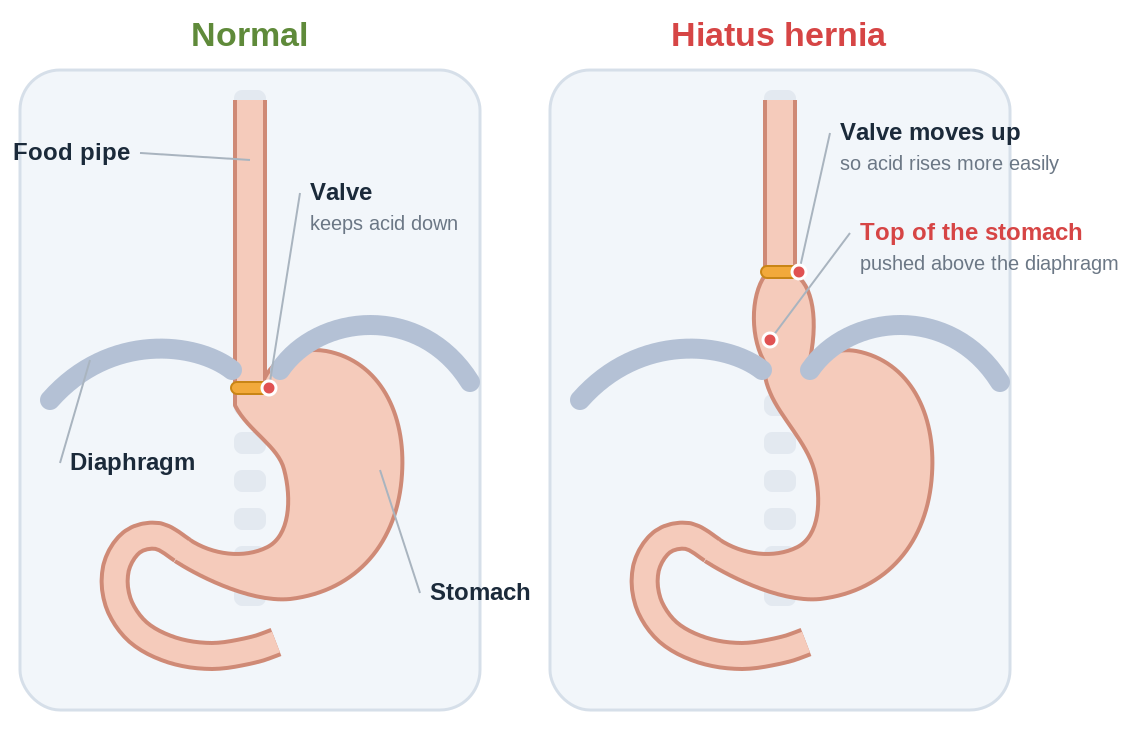
This diagram is a general guide and not a diagnosis. Everyone’s anatomy is different.
Common symptoms
Heartburn, acid reflux, a sour taste, belching, discomfort after meals or food feeling stuck. Many people with a hiatus hernia have no symptoms.
Two main types
A sliding hiatus hernia is the most common type. A paraoesophageal hernia is less common and may need closer follow-up.
How is it checked?
Dr Ahmad can review your symptoms and, if needed, arrange a gastroscopy to look at the lining of your oesophagus and stomach.
See a doctor promptly if you have difficulty swallowing, vomiting blood, black stools or unexplained weight loss. For severe chest pain, call 999 or go to A&E.
Book a consultationPossible causes of acid reflux and heartburn
There is often more than one cause. Several factors can combine, and they differ from person to person.
Weak valve
The valve at the bottom of the food pipe can relax or weaken, letting acid travel upwards (the lower oesophageal sphincter).
Stress and anxiety
Stress can make the gut more sensitive and make heartburn feel worse.
Food and drink triggers
Fatty or spicy meals, caffeine, fizzy drinks and alcohol can set symptoms off.
Hiatus hernia
Part of the stomach can push up into the chest, making acid reflux more likely.
Some medicines
Anti-inflammatory painkillers, some blood pressure tablets and some other medicines can irritate the stomach or relax the valve.
Meal timing and habits
Large meals, eating late, smoking, extra weight and pregnancy can all add pressure on the stomach.
Why choose Dr Ahmad for your acid reflux and heartburn assessment?
Expert care, clear answers and support at every step.
Consultant-led care
Dr Ahmad sees you himself, from your first consultation to your results. He is a consultant gastroenterologist with a PhD from Imperial College London, has published widely on endoscopy and has carried out more than 4,500 procedures.
Seen quickly
Consultations are usually available within 1 to 2 weeks, including evenings and weekends, in person or remotely.
Tests and support in one place
Tests such as H. pylori testing and a gastroscopy, if needed, can be arranged through Dr Ahmad, so you aren’t passed between services. He can also refer you to a specialist dietitian at Welbeck London for diet and lifestyle advice.
A plan you understand
You leave with a clear explanation of what may be causing your symptoms, which tests (if any) you need, and what happens next.
How acid reflux and heartburn are diagnosed
From your first appointment to a clear answer.
Consultation
Dr Ahmad listens to your symptoms, diet, medicines and history.
Examination
An examination of your tummy and a check of your weight and general health.
Tests if needed
Blood tests to check for anaemia, and a stool or breath test for H. pylori, a stomach infection that can cause indigestion and ulcers.
Camera test if needed
A gastroscopy or other tests, such as 24-hour acid (pH) monitoring and oesophageal manometry, which measures how the food pipe squeezes, if your symptoms or results suggest another cause or treatment is not working.

Your specialist, Dr Ahmir Ahmad
Consultant Gastroenterologist and Specialist Endoscopist
Dr Ahmad qualified in medicine from University College London in 2010. He completed a four-year specialist endoscopy fellowship at St Mark’s Hospital from 2018 to 2022, and a PhD at Imperial College London in 2023 on improving the quality of colonoscopy, so that polyps and early bowel cancers are found more reliably. He has a special interest in diagnosing upper gut conditions such as acid reflux and heartburn and in making sure other causes of your symptoms are not missed. He continues to perform endoscopy at St Mark’s, The National Bowel Hospital, and has carried out more than 4,500 procedures.
- Qualifications MBBS, BSc, MRCP, PhD
- Professional registration GMC 7090128 · Specialist Register
- Practises at Welbeck London · Nuffield Brentwood · Spire Hartswood · St Mark’s TrustPlus
- Experience 4,500+ procedures
Medically reviewed by Dr Ahmir Ahmad. Last reviewed 28 October 2026.
Testimonials
What patients say
What patients say about their consultations and procedures.
“I was dealt with very sympathetically and professionally by Dr Ahmad, this was over the course of three consultations and an endoscopy. Any worries I had about the treatment were unfounded and the endoscopy was a quick and painless procedure. I was quickly reassured there were no significant issues and have been discharged back to my GP. So pleased to have been under Dr Ahmad’s care. ”
“I recently visited Dr Ahmir Ahmad as I was suffering from gastric reflux. I felt that he listened to me and my concerns and put my mind at ease regarding the treatment plan.”
“Dr Ahmad was very friendly and informative. He spent a lot of time listening.”
“Initial consultation and follow up were well organised with good questioning regarding symptoms followed by a good explanation of test results with various options clearly outlined.”
Frequently asked questions
-
Acid reflux is stomach acid flowing back up into the food pipe. Heartburn is the burning feeling it causes. When reflux happens often enough to cause troublesome symptoms or inflammation, it’s called gastro-oesophageal reflux disease (GORD).
-
Yes. Acid reaching the throat can cause a cough, hoarseness, throat clearing or a feeling of a lump in the throat, sometimes with little heartburn. This is often called silent reflux (laryngopharyngeal reflux).
-
You can’t always tell. Call 999 if chest pain is crushing or tight, spreads to your arm, jaw or back, or comes with sweating, breathlessness or feeling faint. Heart problems should always be ruled out first.
-
An antacid or alginate (such as Gaviscon) from a pharmacy works within minutes. Sit upright, loosen tight clothing and avoid lying down for 3 hours after eating.
-
Antacids and alginates work within minutes but last a few hours. Acid-reducing tablets (PPIs), such as omeprazole or lansoprazole, take a few days to work fully and are usually taken for 4 to 8 weeks, then reduced to the lowest dose that controls symptoms. Take PPIs 30 to 60 minutes before a meal for the best effect.
-
Common triggers include fatty or spicy food, caffeine, alcohol, chocolate, fizzy drinks, large meals and eating late. Helpful changes include:
- Eating smaller meals.
- Finishing eating 3 hours before bed.
- Raising the head of your bed by 10–20 cm.
- Losing weight if you’re overweight.
- Stopping smoking.
-
For most people, yes, and the benefits outweigh the risks when they’re needed. Long-term use has been linked to low magnesium and B12, a slightly higher risk of fractures and some gut infections. Review your dose at least yearly and use the lowest dose that works. Don’t stop a prescribed PPI suddenly without advice, as symptoms can rebound.
-
Rarely. Long-term reflux can cause Barrett’s oesophagus, a change in the lining of the food pipe that carries a small increase in cancer risk. Most people with reflux, and most people with Barrett’s, never develop cancer. A gastroscopy can check for Barrett’s if you’ve had reflux for many years.
-
Dr Ahmad will usually recommend a gastroscopy if you have difficulty swallowing, unexplained weight loss, vomiting, anaemia or black stools; if you’re 55 or over with new symptoms; if symptoms continue despite treatment; or if you’ve had reflux for many years. Difficulty swallowing should always be checked promptly.
-
Specialist tests, such as 24-hour pH monitoring and manometry, can confirm whether reflux is the cause and guide further treatment. For a small number of people, an anti-reflux operation or procedure may be an option.
-
You don't need a GP referral to book if you're paying for yourself. If you're using health insurance, your insurer may ask for a GP referral before authorising your consultation, so check with them first. Consultations are usually available within 1 to 2 weeks, in person or remotely.
Get in touch
Have a question about acid reflux and heartburn? We’re happy to help.
-
Call now
Phone
07435 081678Dr Ahmad’s secretary, Monday – Friday, 9:00am – 5:00pm
-
Send an email
Email
clinic@drahmirahmad.com
Clinic times
-
Monday12:00–14:00Welbeck London
-
Tuesday08:00–09:00St Mark’s TrustPlus
-
Wednesday10:30–12:00Spire Hartswood14:00–16:00Nuffield Brentwood18:00–20:00Welbeck London
-
Saturday09:00–11:00Spire Hartswood or Nuffield Brentwood
-
Monday
Struggling with acid reflux and heartburn?
See Dr Ahmad at Welbeck London, Nuffield Brentwood, Spire Hartswood or St Mark’s TrustPlus, for a clear diagnosis and a plan to manage your symptoms. Consultations are available in person, by video or by phone.