Coeliac disease in London and Essex
Coeliac disease is a common long-term condition in which the immune system reacts to gluten and damages the lining of the small bowel. It can cause tummy pain, bloating, diarrhoea or tiredness, often for years. Dr Ahmad can confirm the diagnosis with a blood test and gastroscopy, and help you manage it for the long term.
- Consultant Gastroenterologist and Specialist Endoscopist at St Mark's, The National Bowel Hospital
- PhD in colonoscopy quality, Imperial College London
- 4,500+ procedures
Consultations usually available within 1 to 2 weeks, including evenings and weekends, in person or remotely.

The condition
Coeliac disease at a glance
The key facts about coeliac disease, from the signs to look for to when to get checked.
Signs
Bloating, tummy pain, diarrhoea or constipation, tiredness, weight loss and mouth ulcers. Some people have few gut symptoms at all.
Types
It can show up mainly as gut symptoms, or with few gut symptoms but anaemia or low vitamin levels. A related itchy, blistering skin rash is called dermatitis herpetiformis.
Causes
It is an autoimmune condition. The immune system reacts to gluten in wheat, barley and rye and damages the lining of the small bowel. It runs in families.
Get checked
Symptoms that last more than 4 weeks, or a close relative with coeliac disease, are worth a proper assessment. Keep eating gluten until you are tested, as cutting it out first can hide the result.
Urgent
Weight loss you can’t explain, blood in your stool, ongoing diarrhoea with extreme tiredness, or difficulty swallowing need prompt review. If you have severe tummy pain or heavy bleeding, call 999 or go to A&E.
Next step
A consultation with Dr Ahmad to review your symptoms, arrange a blood test and a gastroscopy with biopsies if needed, and agree a plan.

The condition
What is coeliac disease?
Coeliac disease is a common condition in which the immune system reacts to gluten, a protein found in wheat, barley and rye. This damages the lining of the small bowel, so it can’t absorb nutrients as well as it should. It is not a food allergy or intolerance, and it is lifelong. A strict gluten-free diet allows the bowel to heal and prevents long-term complications.
Coeliac disease is diagnosed with a simple blood test, usually followed by a gastroscopy with small samples (biopsies) from the small bowel to confirm it. Dr Ahmad will listen to your symptoms and ask about your diet and family history. Keep eating gluten until you have been tested, as cutting it out first can hide the result.
Coeliac disease can cause:
- Bloating, tummy pain or wind
- Diarrhoea, constipation or tiredness
- Anaemia, low vitamin levels or mouth ulcers, sometimes with few gut symptoms
Coeliac disease and low iron
Coeliac disease is a common reason for iron deficiency that does not improve with iron tablets or a better diet. It is often missed, because symptoms can be mild, or can look like irritable bowel syndrome.
What happens in the bowel
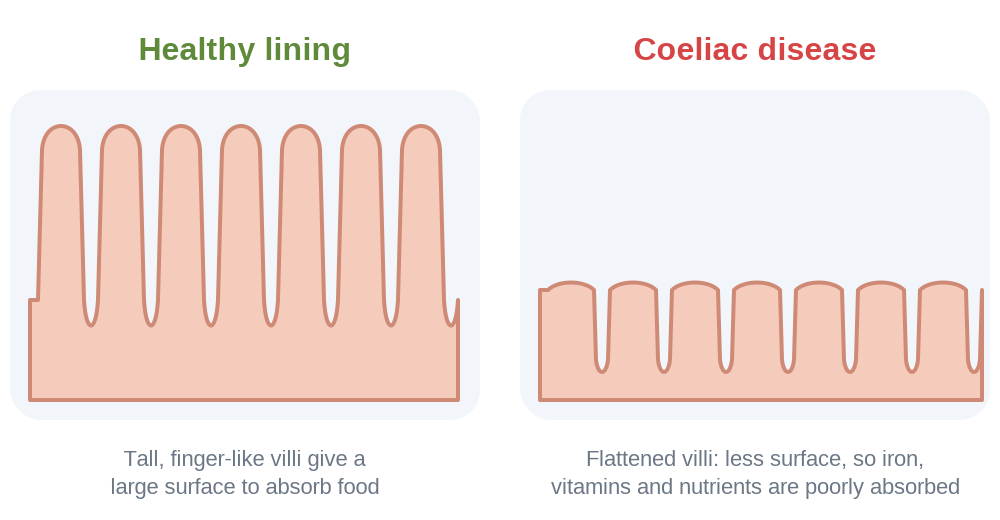
The lining of a healthy small bowel is covered in tiny, finger-like folds called villi. They give the bowel a large surface to absorb food. In coeliac disease, gluten triggers the immune system to damage this lining. The villi become flattened, the surface shrinks, and iron, vitamins and other nutrients are poorly absorbed.
Signs to look out for
Tiredness, bloating, diarrhoea or constipation, stomach discomfort, weight loss, mouth ulcers and low iron or vitamin levels. Some people have very few symptoms.
How we find out
A simple blood test is the first step. If it points to coeliac disease, a gastroscopy lets us take tiny samples from the duodenum to confirm it.
What helps
A gluten-free diet allows the lining to heal, and iron levels usually recover. Please keep eating gluten until you have been tested, as stopping early can hide the result.
Types of coeliac disease
Coeliac disease can show up in different ways. How it affects you helps guide testing and treatment.
Classical coeliac disease
Gut symptoms such as diarrhoea, bloating, tummy pain and weight loss.
Non-classical coeliac disease
Few gut symptoms, but tiredness, anaemia, low vitamin levels or mouth ulcers.
Dermatitis herpetiformis
An itchy, blistering skin rash linked to coeliac disease, often on the elbows, knees and buttocks.
Possible causes of coeliac disease
Coeliac disease needs both a trigger and a genetic tendency. Several factors can combine, and they differ from person to person.
Autoimmune reaction
The immune system reacts to gluten and attacks the lining of the small bowel by mistake.
Genes and family history
Most people with coeliac disease carry the HLA-DQ2 or DQ8 gene, and a close relative raises your risk.
Gluten in the diet
Gluten is found in wheat, barley and rye. It is the trigger, so symptoms ease on a gluten-free diet.
Past gut infection
A stomach bug may help set off coeliac disease in some people who are already at risk.
Other autoimmune conditions
Type 1 diabetes and autoimmune thyroid disease are linked with a higher chance of coeliac disease.
Can start at any age
It can appear in childhood or later in life, even if you have eaten gluten without problems for years.
Why choose Dr Ahmad for your coeliac disease assessment?
Expert care, clear answers and support at every step.
Consultant-led care
Dr Ahmad sees you himself, from your first consultation to your results. He is a consultant gastroenterologist with a PhD from Imperial College London, has published widely on endoscopy and has carried out more than 4,500 procedures.
Seen quickly
Consultations are usually available within 1 to 2 weeks, including evenings and weekends, in person or remotely.
Tests and support in one place
Blood tests, and a gastroscopy with small bowel biopsy if needed to confirm the diagnosis, can be arranged through Dr Ahmad, so you aren’t passed between services. He can also refer you to a specialist dietitian at Welbeck London.
A plan you understand
You leave with a clear explanation of what may be causing your symptoms, which tests (if any) you need, and what happens next, including referral to a specialist dietitian and a plan for follow-up.
How coeliac disease is diagnosed
From your first appointment to a clear answer.
Consultation
Dr Ahmad listens to your symptoms, diet and family history.
Examination
A check of your tummy and for signs that you are not absorbing nutrients well, such as anaemia.
Blood tests
A blood test for tTG-IgA antibodies, with a total IgA level to make sure the result is reliable. Keep eating gluten until testing is complete.
Gastroscopy with biopsies
A gastroscopy with several small biopsies from the duodenum to confirm the diagnosis. It takes 5 to 10 minutes.

Your specialist, Dr Ahmir Ahmad
Consultant Gastroenterologist and Specialist Endoscopist
Dr Ahmad qualified in medicine from University College London in 2010. He completed a four-year specialist endoscopy fellowship at St Mark’s Hospital from 2018 to 2022, and a PhD at Imperial College London in 2023 on improving the quality of colonoscopy, so that polyps and early bowel cancers are found more reliably. He has a special interest in diagnosing bowel conditions such as coeliac disease and in making sure other causes of your symptoms are not missed. He continues to perform endoscopy at St Mark’s, The National Bowel Hospital, and has carried out more than 4,500 procedures.
- Qualifications MBBS, BSc, MRCP, PhD
- Professional registration GMC 7090128 · Specialist Register
- Practises at Welbeck London · Nuffield Brentwood · Spire Hartswood · St Mark’s TrustPlus
- Experience 4,500+ procedures
Medically reviewed by Dr Ahmir Ahmad. Last reviewed 28 October 2026.
Testimonials
What patients say
What patients say about their consultations and procedures.
“Dr Ahmad is very professional and has excellent personal skills. I felt immediately impressed and assured on his high level of expertise. Took a good amount of time to throughly look at my issues. Then reacted immediately with a quick plan to move forward. Excellent professional.”
“Dr Ahmad was very friendly and informative. He spent a lot of time listening.”
“Dr Ahmir made me feel so comfortable and safe and informed throughout my consultations and procedure. I was very nervous but his professionalism and care made the entire process very comfortable and I would highly recommend him. Thank you!”
Frequently asked questions
-
Coeliac disease is a lifelong autoimmune condition in which eating gluten (a protein in wheat, barley and rye) makes the immune system attack the lining of the small bowel. This damages the tiny finger-like villi that absorb nutrients. You are not born with the disease, but you are born with the genes for it (HLA-DQ2/DQ8). Around 1 in 100 people in the UK has it, and the risk rises to about 1 in 10 for close relatives.
-
Common symptoms are:
- diarrhoea, bloating, wind, stomach pain or constipation
- nausea, tiredness and unexplained weight loss
- anaemia (low iron, B12 or folate)
- mouth ulcers
- an itchy blistering rash (dermatitis herpetiformis)
- headaches, tingling or numbness in hands and feet
- weak bones
- reflux or heartburn in some people
Many people have mild or non-gut symptoms, which is why it is often missed or mistaken for IBS.
-
Yes. It can start at any age, from toddlers to people in their 70s and 80s. Even if you have eaten gluten for decades, the immune system can start reacting to it later. Triggers may include a gut infection, pregnancy, surgery, severe stress or another autoimmune condition, but the exact trigger is often unknown. It is more common in people with type 1 diabetes, thyroid disease, Down’s syndrome or Turner syndrome.
-
Treated properly, it is manageable and most people live normal lives. Untreated, ongoing gut damage can cause:
- iron, vitamin and mineral deficiencies
- anaemia
- osteoporosis
- infertility or miscarriage
- nerve problems
Rarely, long-term untreated disease increases the risk of small bowel cancer or lymphoma. A strict gluten-free diet lets the gut heal and brings the risks back close to normal.
-
- Step 1: A blood test for tTG-IgA antibodies, plus total IgA. Dr Ahmad can arrange this.
- Step 2: If the result is positive, a gastroscopy with small bowel biopsies usually confirms the diagnosis.
- Important: Keep eating gluten in more than one meal every day for at least 6 weeks before testing.
- Home tests: Finger-prick kits are a screening tool only. A positive result still needs confirmation with a blood test and gastroscopy.
-
Avoid anything made with wheat (including spelt, durum, semolina and couscous), barley and rye. This includes bread, pasta, pizza, cakes, biscuits, pastry, most breakfast cereals, beer and lager, batter and breadcrumbs, gravy mixes, sauces (soy sauce, some ketchups), ready meals and sausages containing rusk. Gluten also hides in soups, stock cubes and sweets. Always check labels. “Gluten free” means less than 20 parts per million (ppm) by law, and products labelled “may contain” gluten should generally be avoided.
-
- Oats: Only oats labelled “gluten free” are safe, because standard oats are usually cross-contaminated. About 1 in 10 people with coeliac disease may still react to gluten-free oats.
- Chocolate: Plain chocolate is often fine, but check for barley malt, wafers, biscuit pieces and “may contain gluten” warnings.
- Alcohol: Wine, cider, spirits, port, sherry and liqueurs are gluten free. Regular beer, lager and ale are not, so choose beers labelled gluten free.
-
No. Non-coeliac gluten sensitivity causes symptoms like bloating, tiredness and headaches after eating gluten, but there is no autoimmune reaction and no gut damage, and no test confirms it. Wheat allergy is also different. Coeliac disease must be ruled out first, which is why you should test before cutting out gluten.
-
The only treatment is a strict, lifelong gluten-free diet. This heals the gut, usually within months, though full recovery may take longer in adults. To manage it:
- Avoid cross-contamination: use a separate toaster, separate butter and clean utensils, and tell restaurants you are coeliac.
- Check the Coeliac UK food and drink guide or its app.
- Have an annual review, including blood tests, weight and nutrition checks. Dr Ahmad can provide this or share a plan with your GP. A bone density scan may be advised at diagnosis.
- Ask your doctor about calcium and vitamin D if your diet is lacking.
Gluten-free food on prescription varies by area and is now limited in many places, so check your local policy.
-
Yes. You can book a consultation without a GP referral if you're paying for yourself, and Dr Ahmad can arrange the blood tests, gastroscopy and referral to a specialist dietitian. You don't need a GP referral to book if you're paying for yourself. If you're using health insurance, your insurer may ask for a GP referral before authorising your consultation, so check with them first. For day-to-day support with a gluten-free diet, Coeliac UK has a helpline, app and local groups.
-
Yes, but you'll need to reintroduce gluten first (a "gluten challenge"): gluten in more than one meal every day for at least 6 weeks before the blood test and gastroscopy. If this makes you very unwell, speak to Dr Ahmad about other options, such as genetic testing to rule coeliac disease out.
-
Close relatives (parents, brothers, sisters and children) have about a 1 in 10 chance of having coeliac disease, so they should be offered a blood test, even if they have no symptoms.
Get in touch
Have a question about coeliac disease? We’re happy to help.
-
Call now
Phone
07435 081678Dr Ahmad’s secretary, Monday – Friday, 9:00am – 5:00pm
-
Send an email
Email
clinic@drahmirahmad.com
Clinic times
-
Monday12:00–14:00Welbeck London
-
Tuesday08:00–09:00St Mark’s TrustPlus
-
Wednesday10:30–12:00Spire Hartswood14:00–16:00Nuffield Brentwood18:00–20:00Welbeck London
-
Saturday09:00–11:00Spire Hartswood or Nuffield Brentwood
-
Monday
Struggling with coeliac disease?
See Dr Ahmad at Welbeck London, Nuffield Brentwood, Spire Hartswood or St Mark’s TrustPlus, for a clear diagnosis and a plan to manage your symptoms. Consultations are available in person, by video or by phone.